AN AI SIDEKICK FOR CONTACT CENTER AGENTS
I've been the designer on Copilot since August 2023, and it's taught me so much about designing for AI.
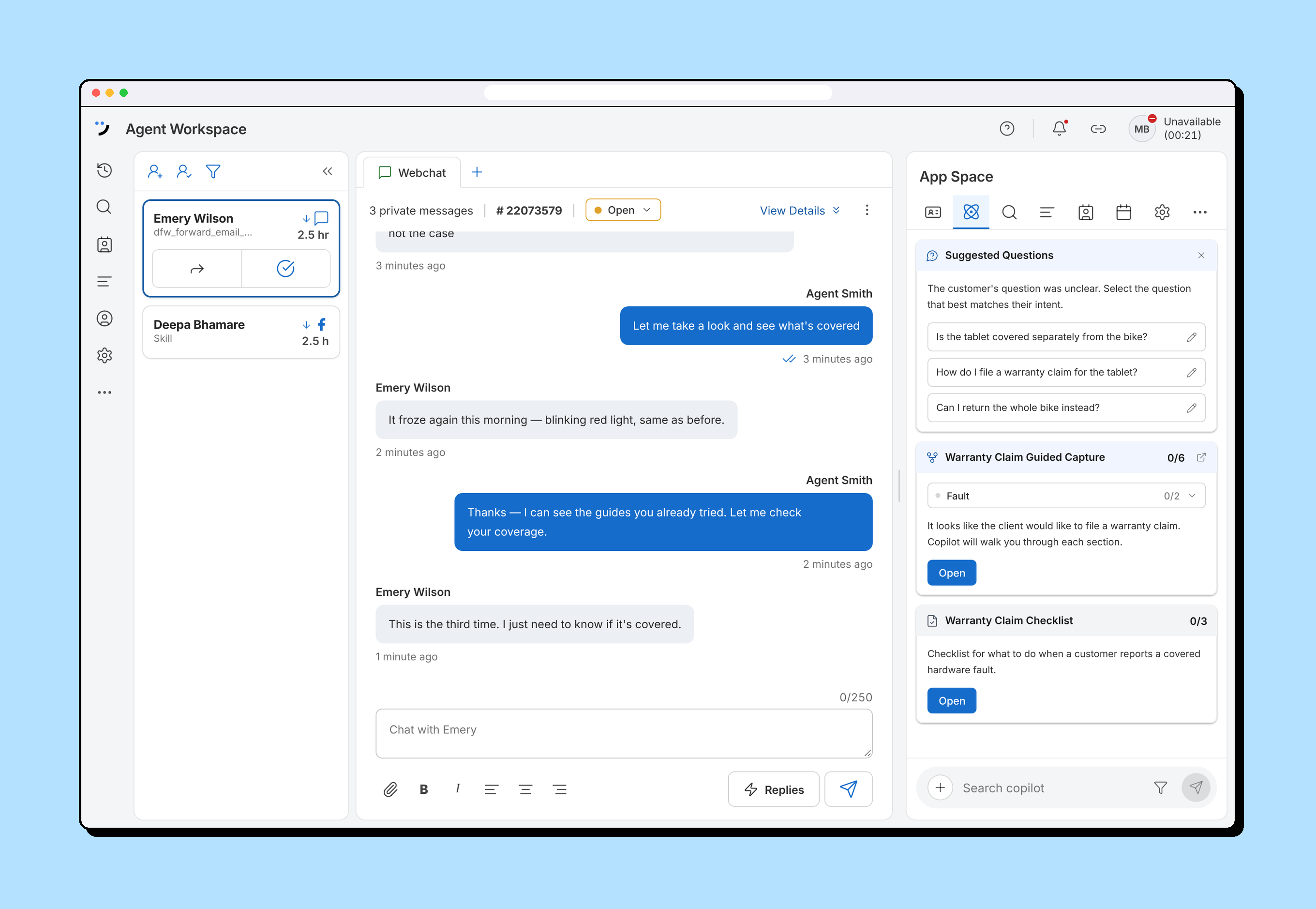
How do you help an agent without slowing them down?
Contact center agents have one of the hardest jobs out there. A customer is on the line or in the chat, three or four other apps are open, and the answer they need is buried in a knowledge base somewhere. NICE's own research found that most agents navigate 3 to 8 apps just to piece together one customer view.
Copilot for Agents was NICE's answer: an AI companion that listens alongside the agent and brings them knowledge, summaries and next steps in real time. But the agents themselves are a really varied group. Some stay in one role for years, others are brand new. Some work in heavily regulated industries like banking and healthcare, others in retail or travel. And a lot of them were already skeptical of AI.
So the real question wasn't what the AI could do. It was what an agent could actually use, mid-conversation, without it becoming one more thing to manage.
Here's something I'm really proud of: research was never on the plan. Nobody asked for it, and it wasn't built into our sprints. But I didn't want to ship AI features to agents based on guesses, so I started requesting research myself, running concept tests with UX researcher Serena Yang and running my own when she wasn't available, all while keeping up with a really tight timeline.
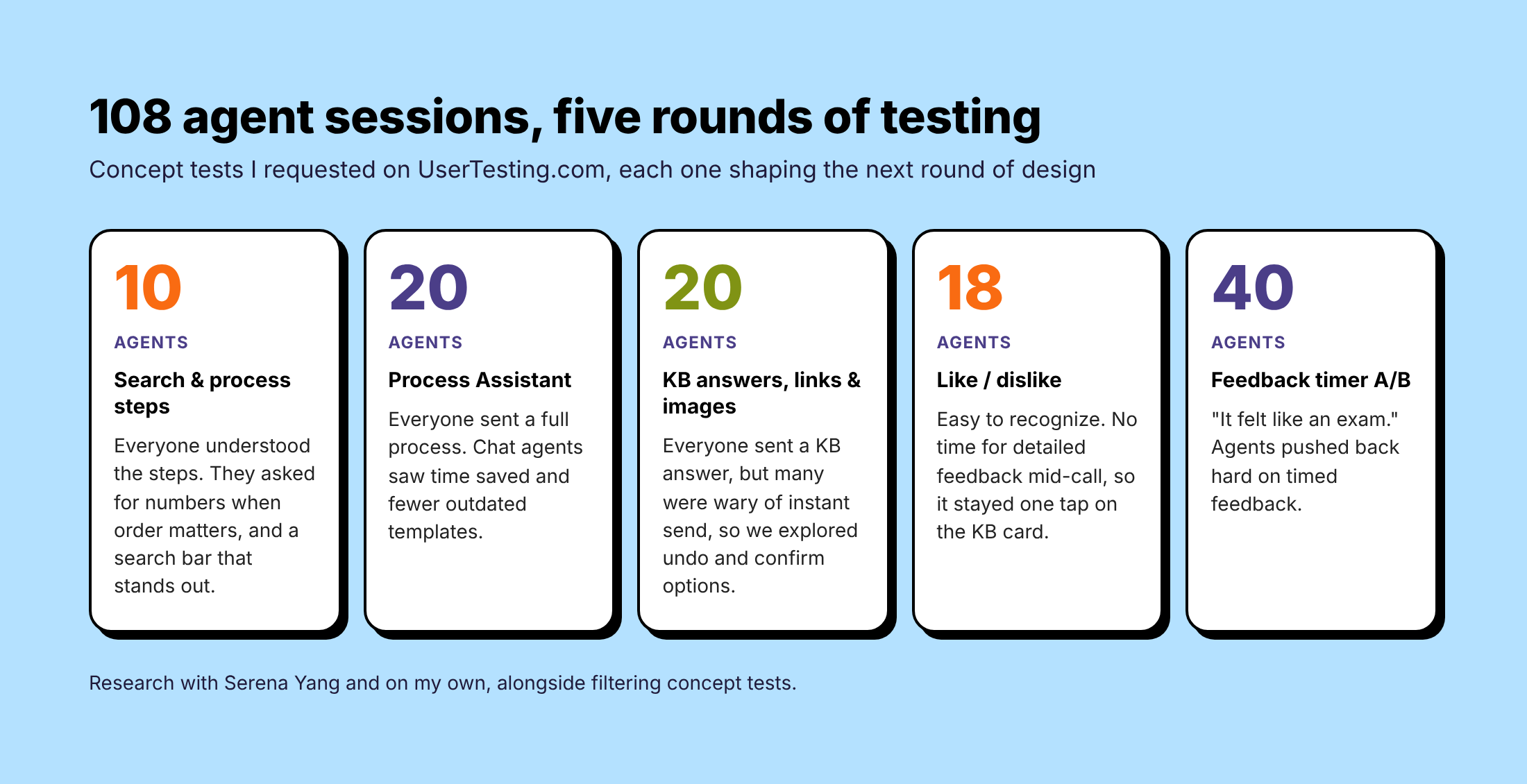
Across five rounds and 108 agent sessions, a few things came up again and again:
- Agents want help, not a babysitter. "AI is usually impersonal but this felt very personal and useful for the customer."
- They need to know where an answer came from. Sentiment without a reason made agents worry about their performance and question its accuracy.
- Nobody wants AI talking to their customer for them. Everyone could send a KB answer, but many were wary of anything that sent instantly.
- Time is everything. "Most call centers never give you the time" for detailed feedback, so anything extra had to take one tap.
Learning how AI works under the hood wasn't part of my role, but I wanted to understand it, so I went beyond the scope of my job and took two Oracle AI courses. That made it so much easier to have honest conversations with my PMs about trade-offs: what AI is genuinely good at, where it isn't, and where the agent should always have the final say.
Real calls, real limits, real skepticism.
- Divided attention. Agents juggle several apps and sometimes several conversations, so every card had to be worth the glance.
- Platform limits. Early cards were built in Microsoft Adaptive Cards, which didn't support everything we designed, so some features needed workarounds and some had to wait.
- Regulated industries. Banks, healthcare and insurance can't risk a paraphrased policy, so knowledge had to be traceable to its source.
- A global workforce. Agents work across countries and languages, so the design couldn't assume one way of working.
- No research on the plan. Research wasn't part of our sprints, so I requested it myself and fit it into very tight timelines.
- Knowing when to step back. Next Best Response turned out to be more challenging than we expected, so we de-scoped it and focused on getting the core experience right.
Help that shows up when agents need it, and steps back when they don't.
Break through the platform's limits
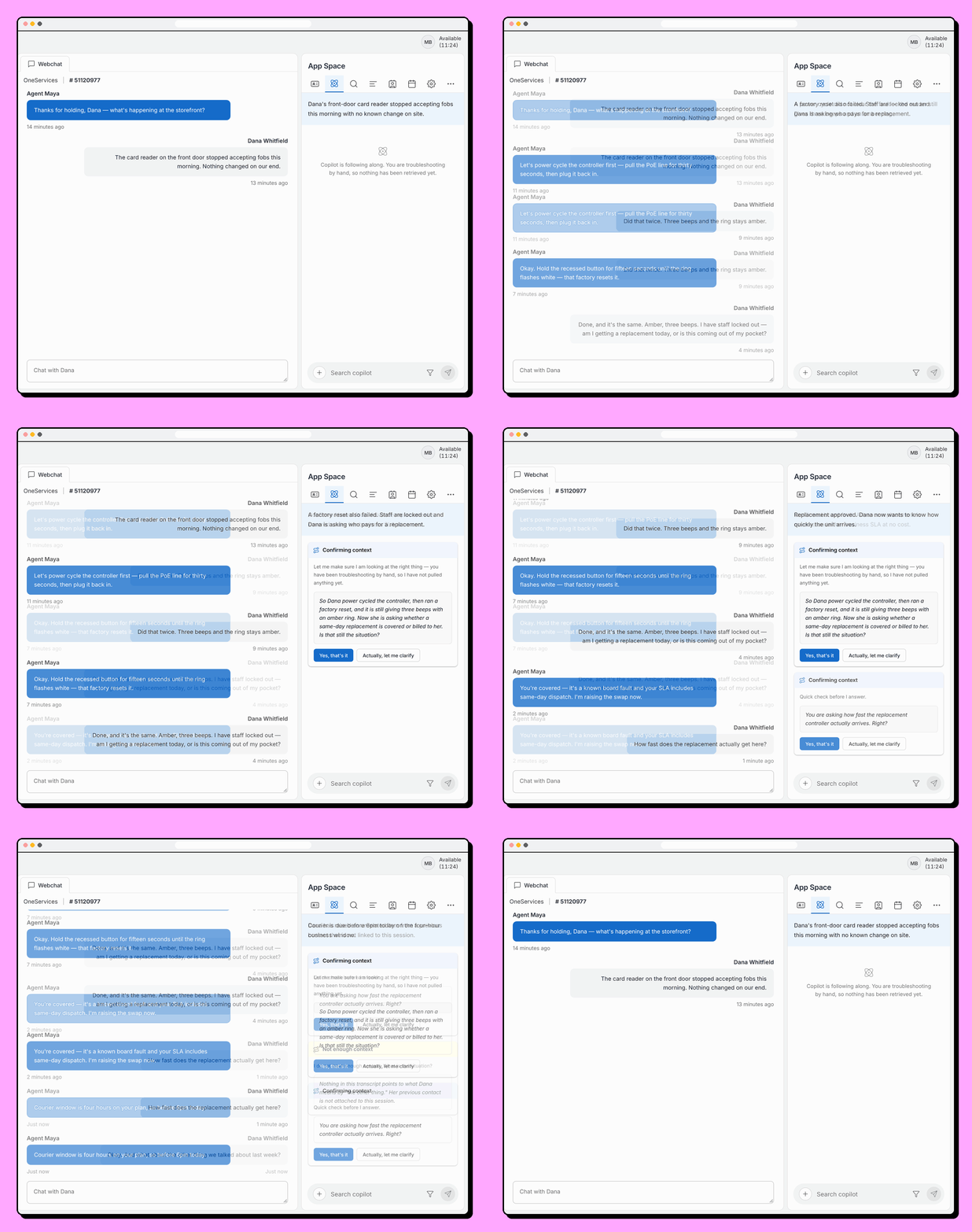
Early on, Copilot's cards were built with Microsoft Adaptive Cards, and they came with some real limits. The biggest one: forms. Adaptive Cards made it hard to submit a form, and just as hard to cancel one, which meant decision trees and process automation were stuck. Other people had given up on it.
I know my way around HTML and CSS, so I went digging, through Stack Overflow, the docs and a lot of trial and error, until I found a way to make submit and cancel work. That unblocked decision trees and process automation for the first time, and it's what makes guided workflows like these possible today.
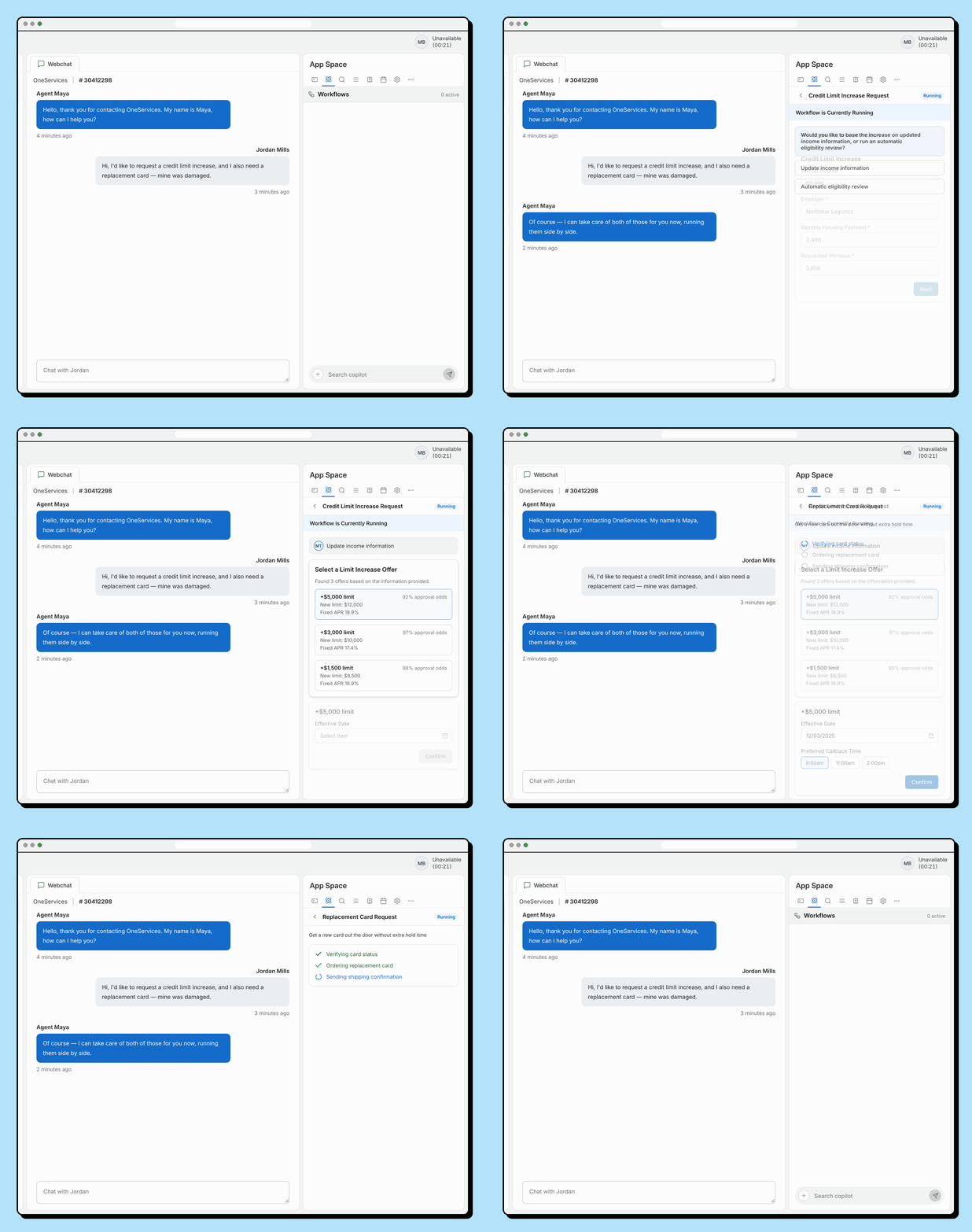
Process steps came straight from research too. Agents could follow them easily, but asked for numbers when the order matters, so a knowledge answer now breaks into steps an agent can send one at a time. In the 2026 concepts, workflows go even further: Copilot recognizes two requests in one message, like a credit limit increase and a replacement card, and runs them side by side.
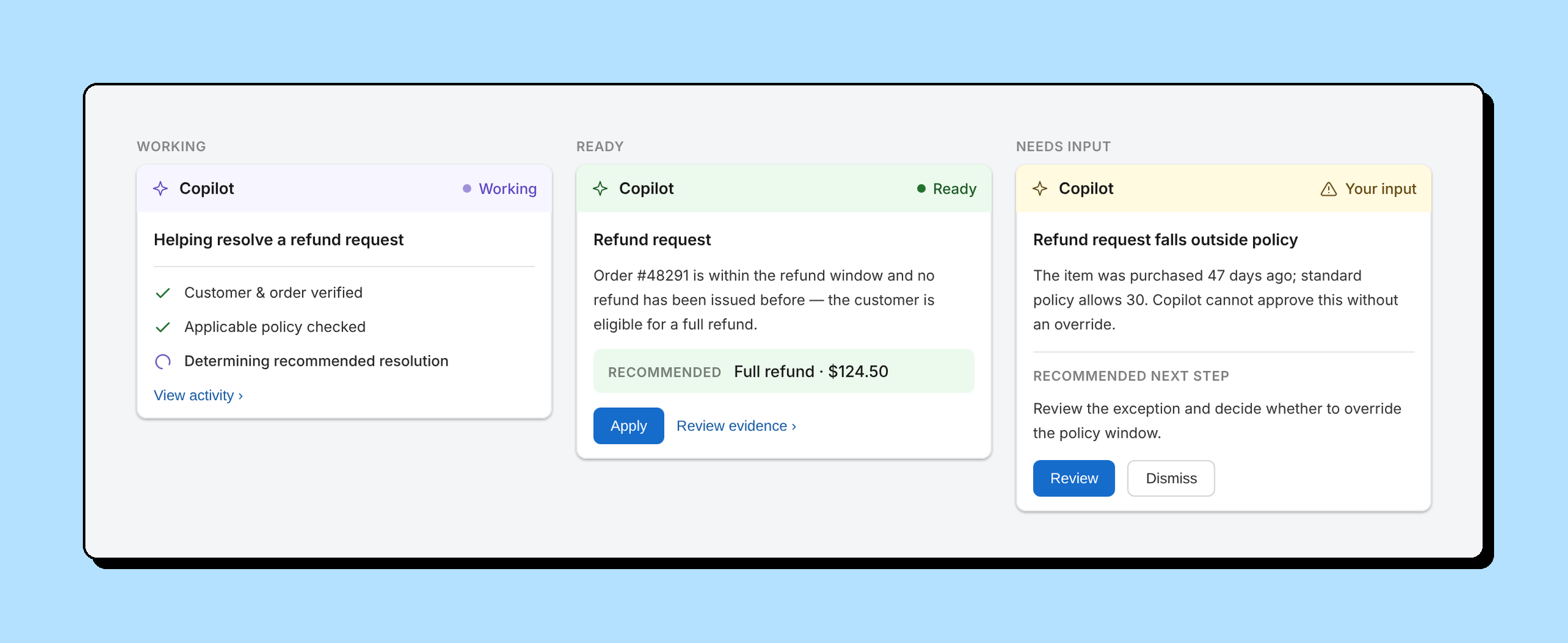
The trade-off: automation is only as good as the agent's trust in it. Every workflow shows what it's doing in plain words, step by step, and pauses for the agent whenever it needs a decision or falls outside policy.
Earn trust before asking for it
AI skepticism came up in our very first round of research, and it shaped everything. Agents had seen what tools like ChatGPT could do, and what they got wrong. So every card in Copilot has to show its work.
Take sentiment. The business loved it, but agents told us it made them anxious about their performance and they didn't know what was driving it. So instead of a constant score, sentiment only updates when it actually changes, and it always says why, like Sentiment declined since the last message. Third reported failure.
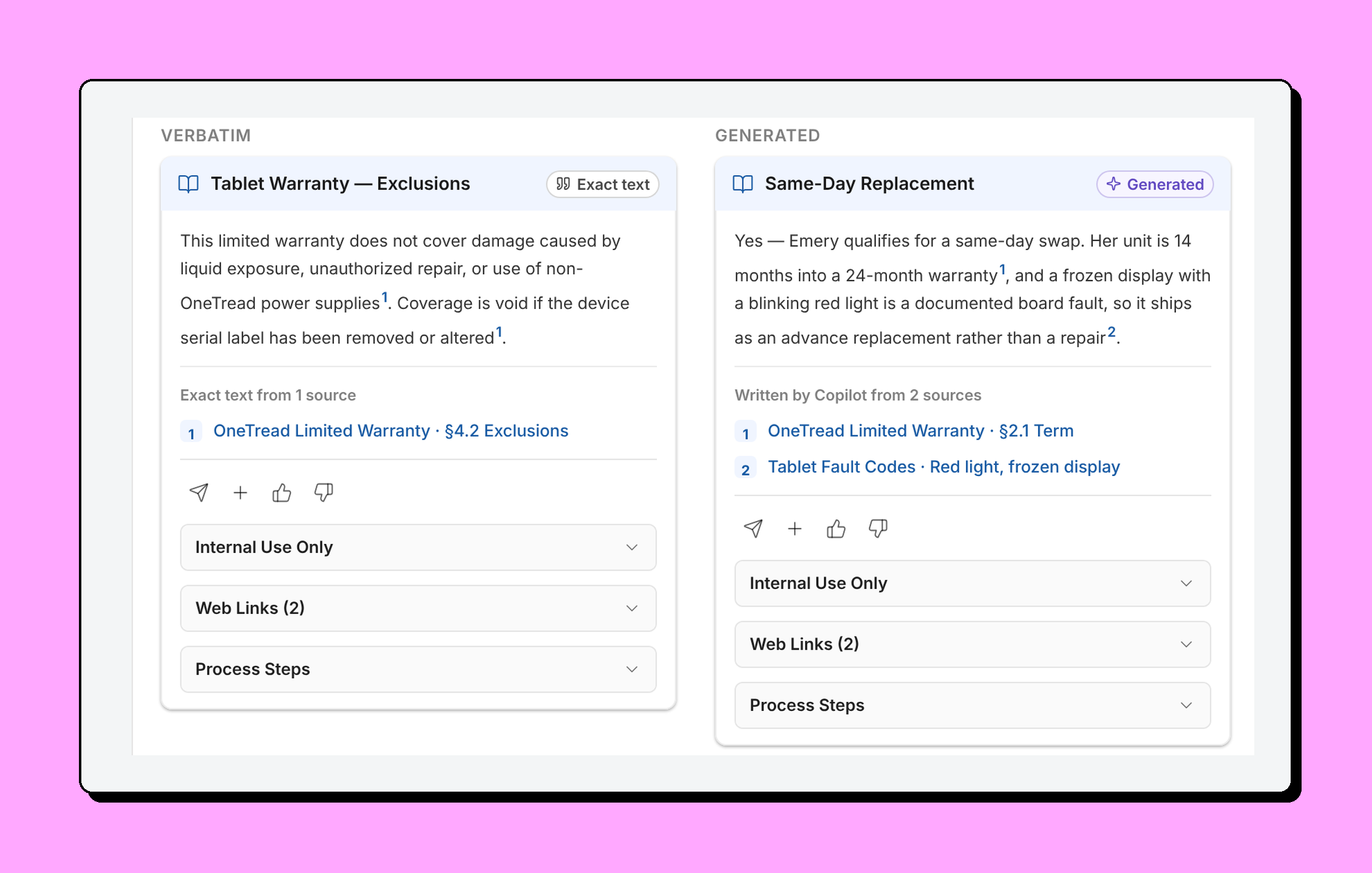
Knowledge answers got the same treatment. In the 2026 concepts, every answer says whether it's the exact text from the knowledge base or written by Copilot, with numbered sources an agent can check in one click. Policy language, prices and legal terms always stay verbatim, because a wrong paraphrase of a policy is worse than a slightly stiff answer.
And when Copilot isn't sure what the agent needs, it asks first. Context confirmation is a quick check that restates the situation in plain words before Copilot answers, a circuit breaker for risky moments, not a step on every question.
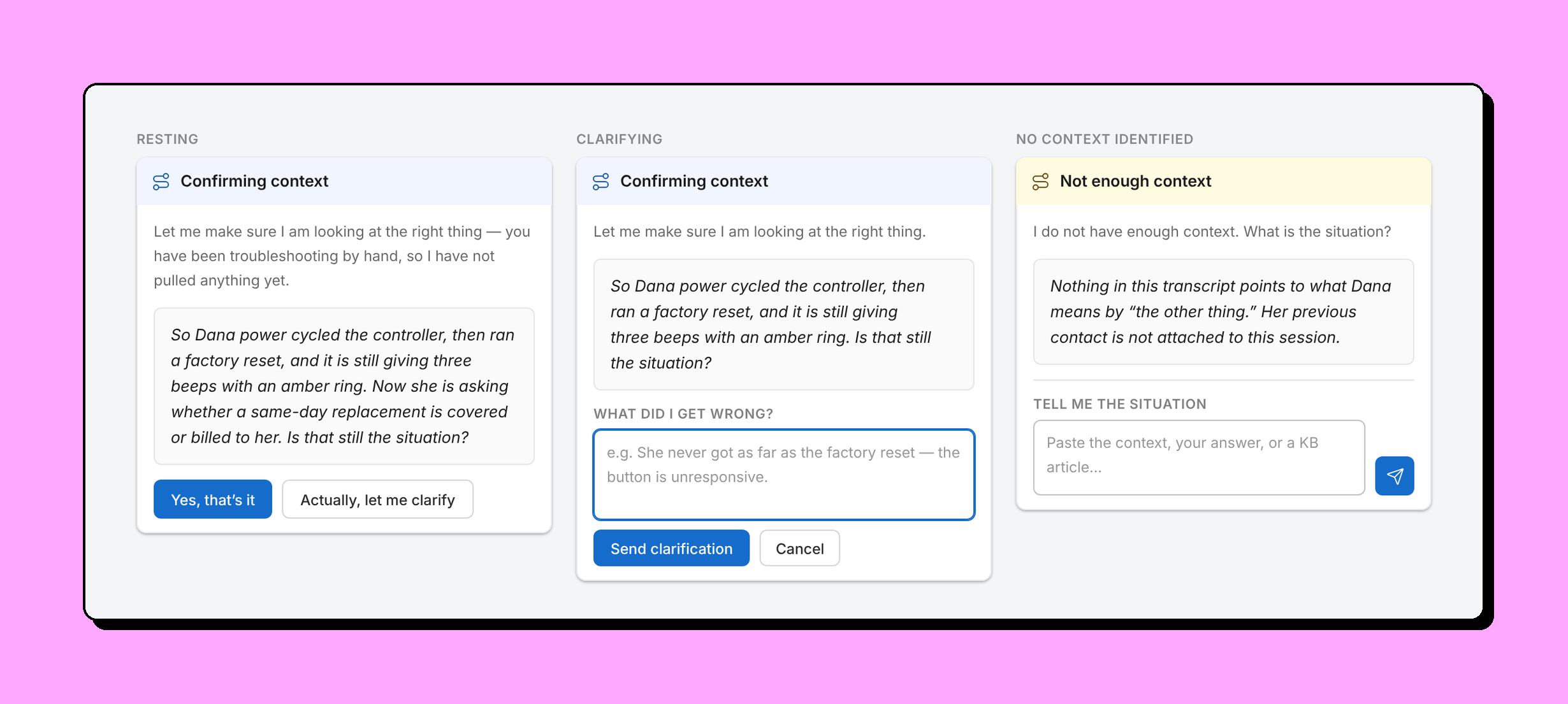
The trade-off: asking before answering adds a beat. We kept it for the moments where a wrong answer costs the most, like refunds and replacements, and let routine questions flow straight through.
Keep the agent in charge
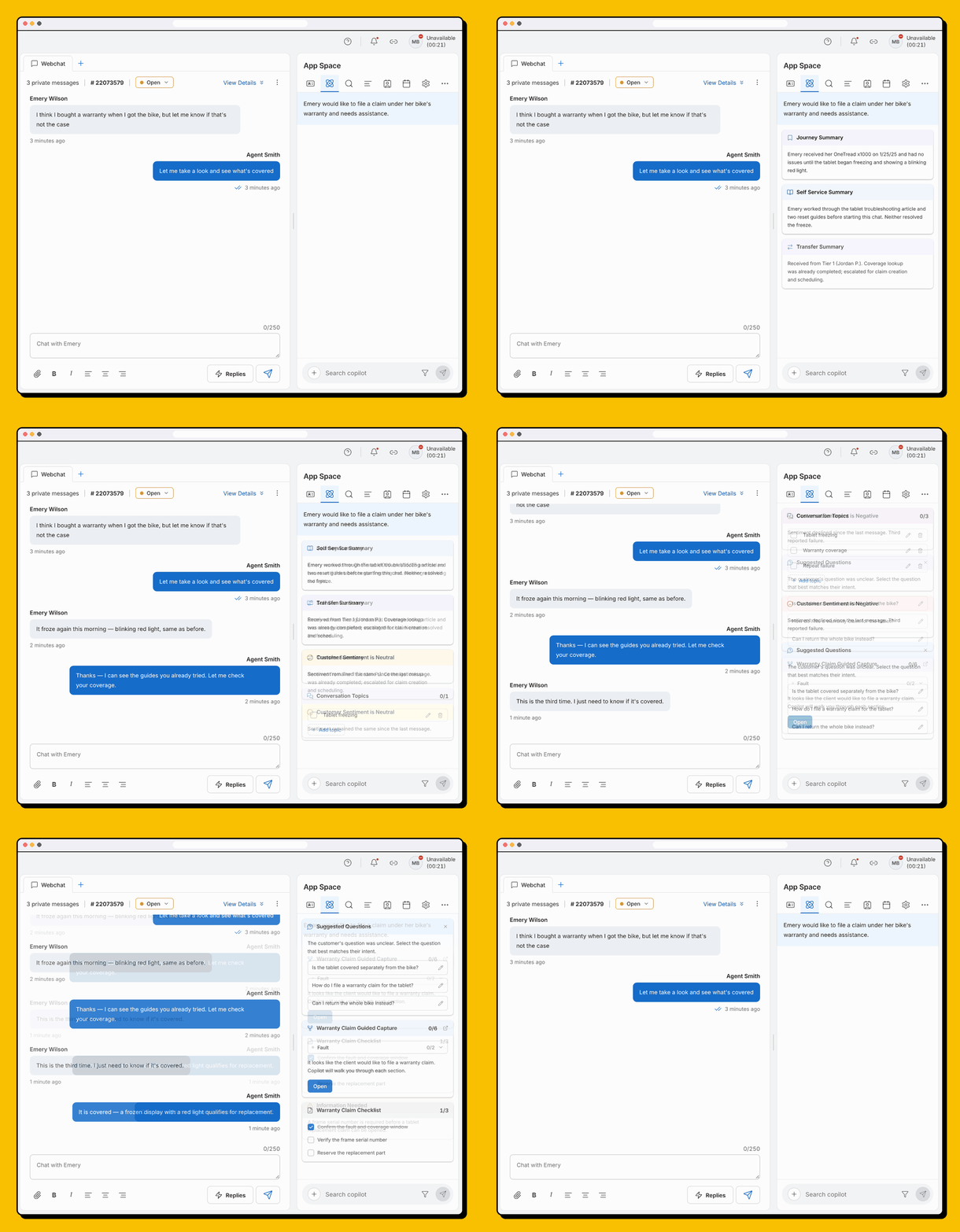
Agents are juggling a customer, other apps and sometimes a second conversation, so Copilot has to fit into their flow, not interrupt it. Everything lives in one App Space panel: a summary of the customer's journey, what they tried in self-service, what the last agent did, sentiment, and the knowledge they need right now.
When a customer's question is unclear, Copilot suggests the questions they might mean, and the agent picks the right one. That small step does a lot of work: it gets the agent a better answer, and it helps the knowledge get more refined over time.
Feedback had to be just as light. We tested a like and dislike on knowledge answers with 18 agents, and they got it instantly ("if anyone is active on social media, you can tell what the like and dislike button does"). Then we A/B tested a timer on feedback with 40 agents, and the answer was a clear no: "It felt like an exam."
The trade-off: detailed feedback would help train the AI faster, but agents on a live call don't have the time. We kept it to one tap on the knowledge card, with more detail available if they want to give it.
Answers buried across 3 to 8 apps, notes typed up after every call, and agents skeptical of AI.
One panel with the summary, sentiment and knowledge they need, workflows that run themselves, and AI that shows its work.
Copilot for Agents is live in NICE CXone today, and it's been so exciting to watch it grow from those first Adaptive Card concepts into a core part of the platform. Real-time summaries, sentiment, knowledge answers, process steps, process automation and transfer summaries are all part of Copilot for Agents now.
The results
The impact on after-call work is one I'm really proud of, and it came from working hand in hand with engineering. NICE reports that Maps Credit Union saw 90 to 94% less after-call work and 21.6% more calls handled per agent per hour. On the same page, NICE shares that Itaú saw 15% faster handle time across a 4,500-agent operation, and that Copilot helped Essent save €2M a year on complex requests escalated to human agents.
One of my favorite stories is a global hospitality brand where Copilot transformed knowledge access for more than 550 agents. We worked through a lot of roadblocks with knowledge to get there: how answers are presented, and when to surface suggested questions so the knowledge keeps getting better.
Copilot also won the 2024 BIG Innovation Award for AI Excellence and a 2024 AI Breakthrough Award as Enlighten Copilot, which was my design. You can read more in the Copilot for Agents data sheet.
Copilot also needed a better way to be shown to customers, which is how Copilot Demo Studio came to be.
Looking back, the biggest thing I've learned is that designing for AI is as much about saying what it shouldn't do as what it can. The best conversations I've had with my PMs weren't about features. They were about trade-offs, and where a person should always stay in the loop.
I've also learned to be proactive. Research wasn't requested, the platform had limits and the timelines were tight, but asking for research anyway and digging for a fix when something seemed impossible is what moved Copilot forward. I'm so grateful to Megan, Serena and the whole Copilot team for building this with me.
