REDEFINING DIGITAL SECURITY
I love digital identity projects, so designing with Kaprion was a dream.
How do you prove you're you, beyond any doubt?
The City of Dresden gives residents with lower incomes a Social Pass, the Dresden-Pass. It unlocks discounts on transit, cultural programs and city services, and it's moving from a plastic card to your phone.
Kaprion's IDealWALLET holds it, backed by some seriously technical zero-trust security. The people carrying it aren't security experts, though. They're everyday residents of every age, and researchers at HTW Dresden put the challenge really well: a pass like this has to work without stigmatizing anyone, and you can't assume everyone has the same digital literacy.
If residents can't tell where a credential came from, or what happens when they share it, they won't trust it. And a pass nobody trusts doesn't get used.
I had the pleasure of working remotely with Kaprion Technologies, a software company based in Dresden. I was the UX designer on IDealWALLET, partnering with their developers and the Kaprion team as a whole.
Digital identity has been a thread through a lot of my work, from GLEIF to healthKERI, and I'll be honest, I love this stuff. So before designing a single screen, I dug into the zero-trust architecture and chain of trust with their developers.
That made the goal really clear. Residents don't need to understand the cryptography. They need answers to three questions:
- Is this real?
- Who vouched for it?
- Who have I shared it with?
And the fastest route to those answers? Patterns people already use every day in their phone wallets and banking apps.
Simple on top, uncompromising underneath.
- Everyone is the audience. The Social Pass is for residents of every age and comfort level with technology, so nothing could assume digital literacy.
- Security can't be simplified. The zero-trust architecture stays exactly as rigorous as it is. Only how it's presented could change.
- No stigma. The Social Pass looks like any other card in your wallet, so nothing singles someone out at the museum door.
- Many issuers, one wallet. City offices, banks, event tickets and building access all live side by side, so every card leads with its issuer's own branding.
- Two languages. Every screen works in German and English, and German labels run long, so layouts needed room to breathe.
- Public sector transparency. In a city pilot, being clear about data isn't a nice-to-have.
A wallet that feels familiar from the first tap.
Start with a wallet everyone recognizes
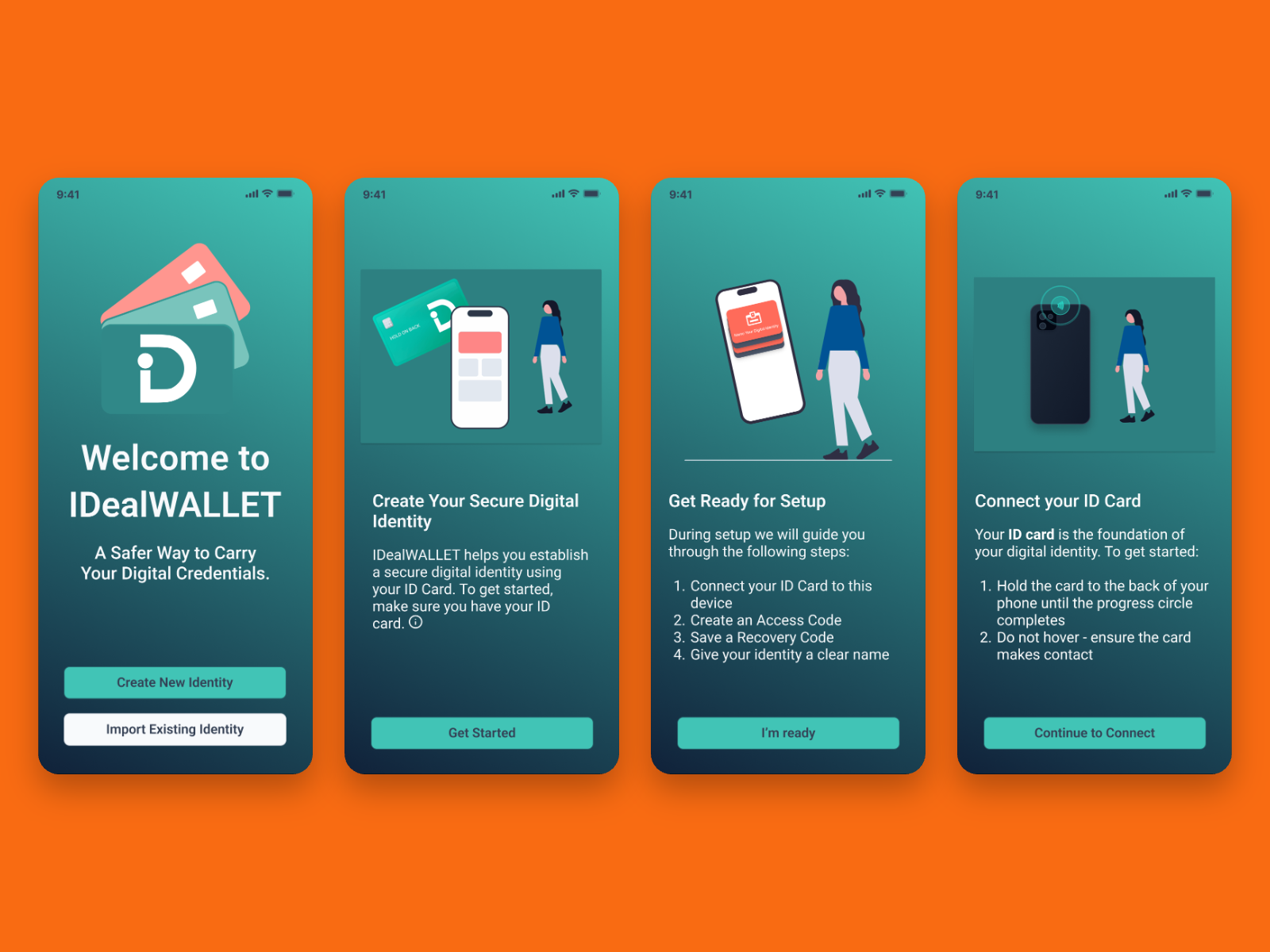
Getting started begins with something residents already carry: their ID card. Before setup even starts, IDealWALLET lays out all four steps: connect your ID card, create an access code, save a recovery code and give your identity a name. No surprises. Then you hold your card to the back of your phone, and a progress circle lets you know it's working.
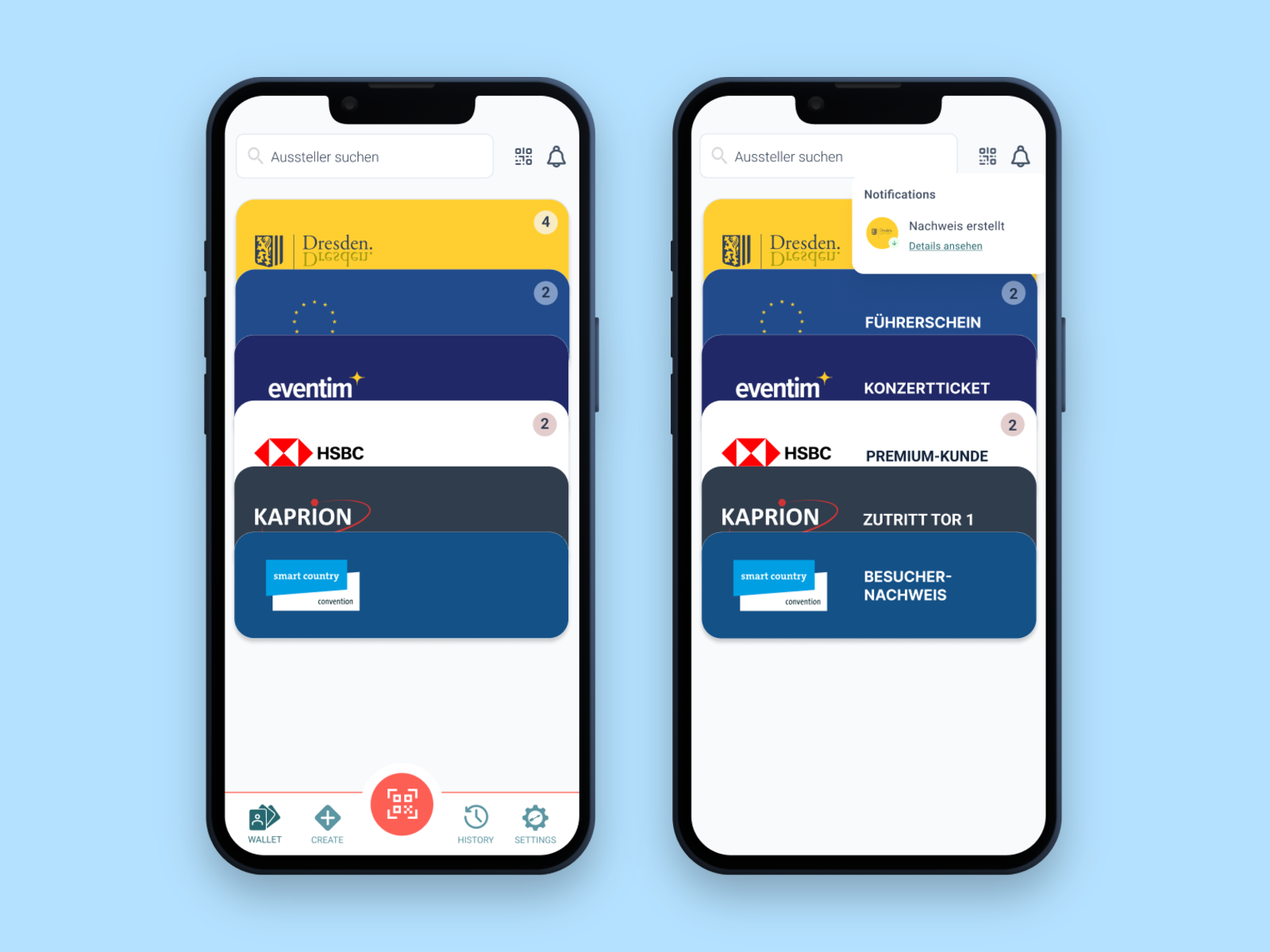
From there, credentials show up as stacked cards, each in its issuer's colors with its logo, just like the cards in your phone's wallet. The Social Pass sits right next to a concert ticket, a bank card or a visitor pass. A little badge tells you when something new happened, search finds a card by issuer, and the big scan button in the middle is there whenever you need a QR code.
The trade-off: stacked cards only show a sliver of each credential. We chose familiar over dense. An issuer's logo and the credential's name are enough to recognize a card at a glance, and one tap opens everything else.
Setup also asks for a physical ID card, which adds a step. But that step is what makes your digital identity trustworthy from day one, so we explained why right on the screen instead of hiding it.

Make the chain of trust readable
This was the heart of the project. Every credential is backed by a chain of trust: who issued it, who authorized them, all the way back to the source. Under the hood, that's signatures and keys. On screen, I wanted it to read like a story.
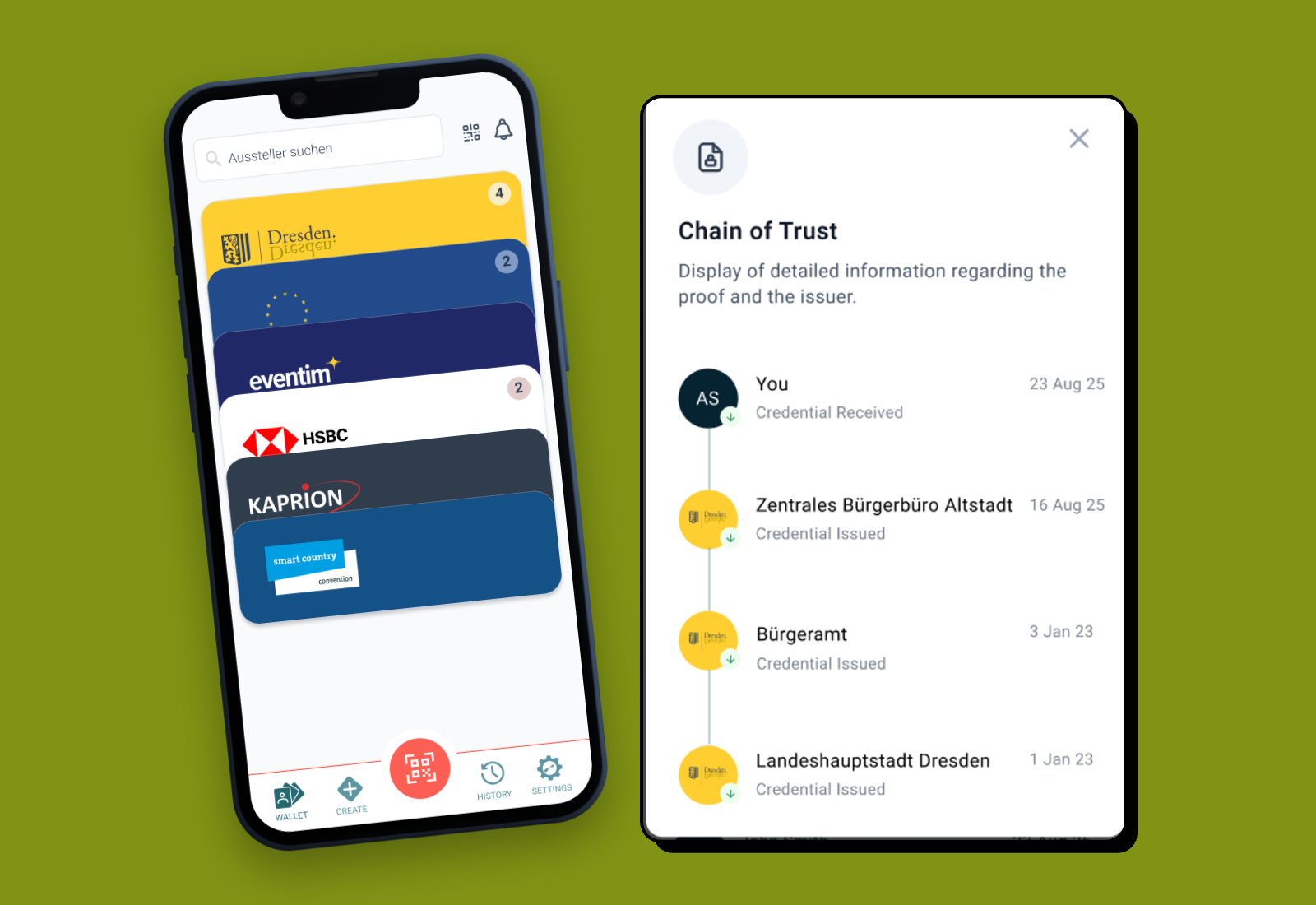
Open any credential and you can pull up its Chain of Trust: a simple timeline showing you received it from the Zentrales Bürgerbüro Altstadt, backed by the Bürgeramt and, at the root, the City of Dresden, each with a date. Real offices residents recognize, in order, in plain words.
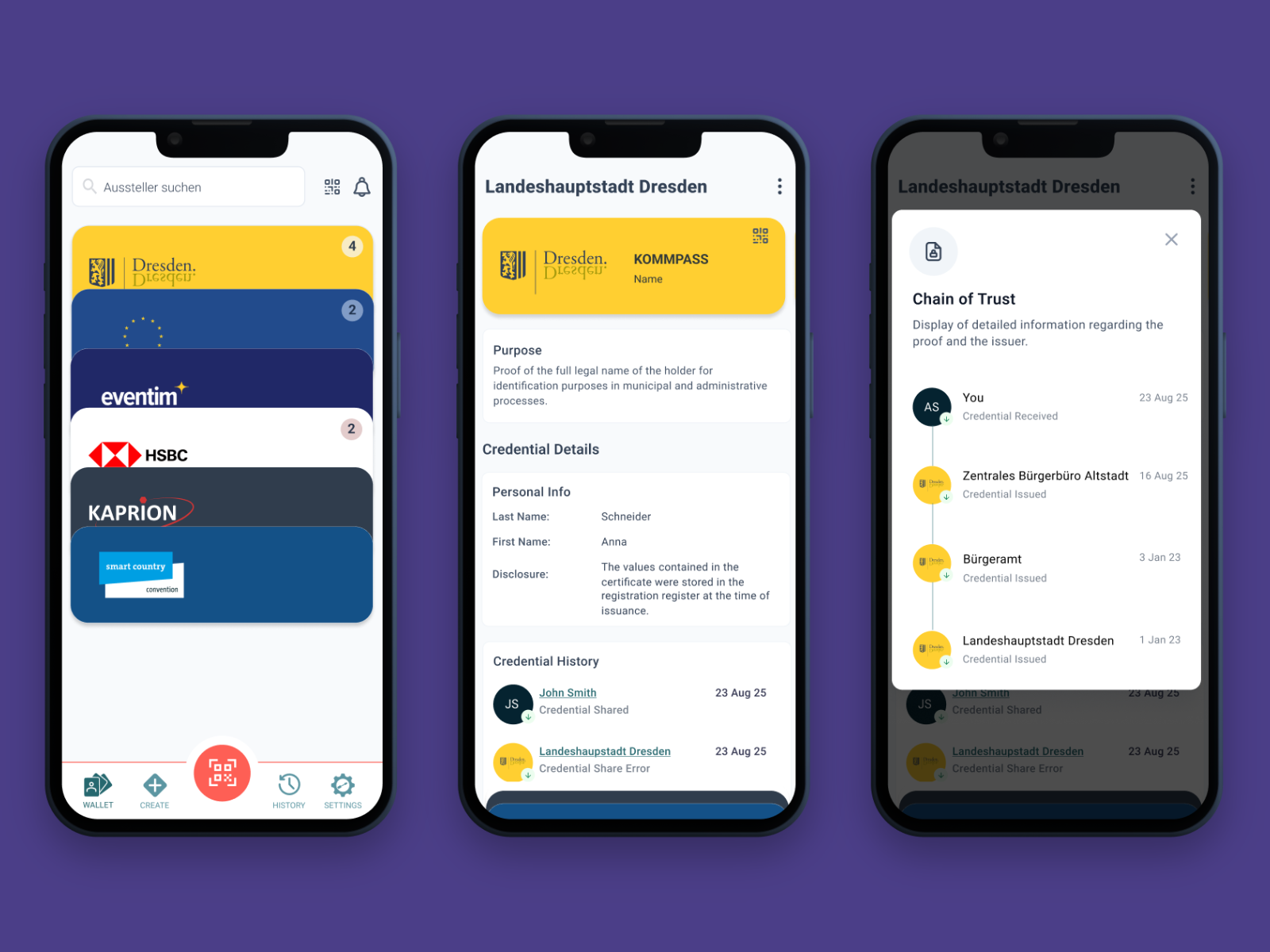
Every credential also explains itself before anything else: a short purpose in plain language, then the details, then a note about the data, like the fact that the values are what was on record when it was issued.
The trade-off: the full cryptographic detail stays hidden. A developer might want to see the keys, but residents need names they know. We kept the chain one tap away instead of on every card, so it's there when you want reassurance and out of the way when you're just trying to catch the tram.
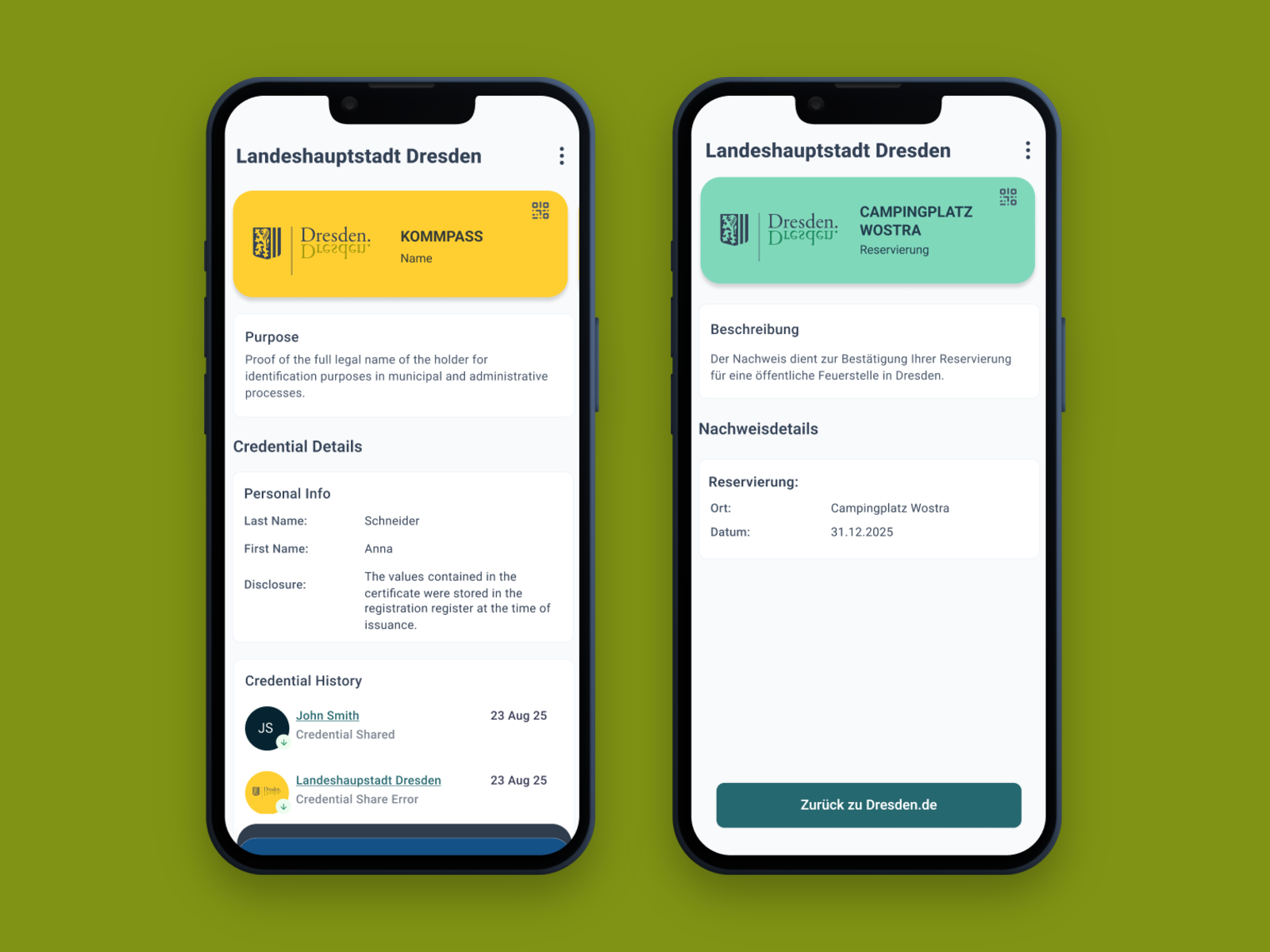
Show every share, like a banking app
Banking apps taught all of us to check our recent transactions, so each credential has its own history: who you shared it with and when. The History tab gathers everything in one place, and notifications let you know when a new credential lands in your wallet.
Errors show up too. If a share doesn't go through, the history says so plainly, right next to the ones that did.
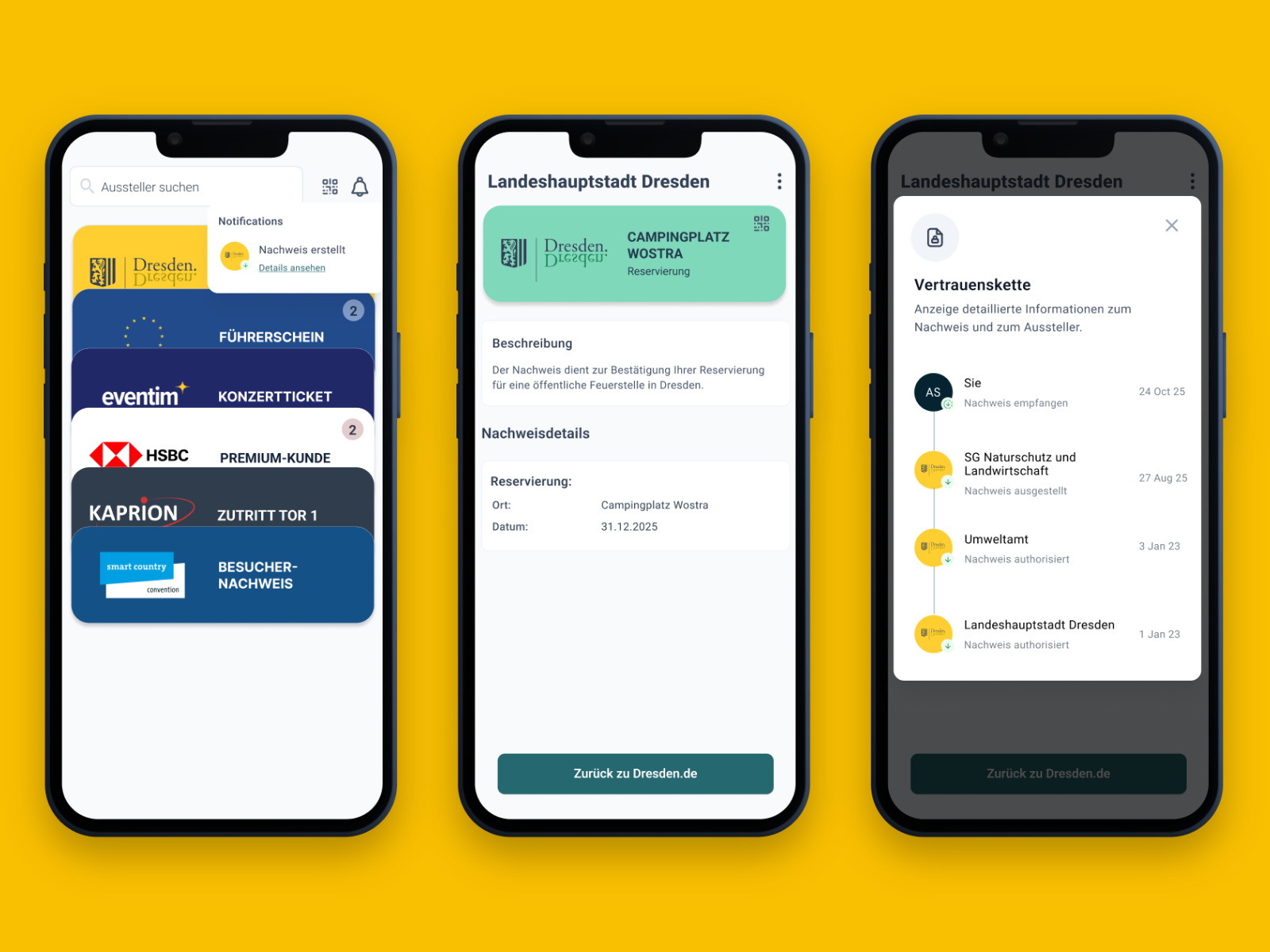
The wallet works in German and English. And when a city service sends you to the wallet, say to confirm a campsite reservation, a big Zurück zu Dresden.de button takes you right back where you started.
We also kept the history to things people actually do, like sharing and receiving, rather than every technical event happening behind the scenes.
Zero-trust security only an engineer could follow.
A wallet residents already know how to use, with every credential's origin in plain sight.
The Social Pass is now in pilot with the City of Dresden! Residents get a wallet that feels familiar from the first tap, with a rigorous zero-trust system doing the heavy lifting underneath. And because every credential follows the same pattern, from a city pass to a concert ticket, it's a foundation Kaprion can build future public services on.
The bigger picture
It's been so exciting to watch Dresden become the first German city testing digital wallets for city services, with the Dresden-Pass among the very first credentials. Kaprion has been part of that wider push too, including bringing student credentials into the wallet with Saxon universities.
As the pilot runs, I'd love to learn how many residents set up their Social Pass without any help, and whether seeing the chain of trust actually raises their confidence. I'd also really love to test setup with older residents, since holding an ID card to the back of your phone is a brand new gesture for a lot of people.
I've learned that the more technical a project is, the more those familiar, everyday patterns matter.
